

Enjoy an exciting journey through the breathtaking trails of the Everest Base Camp Three Pass Trek, surrounded by towering peaks, ancient monasteries, and vibrant Sherpa culture. This adventurous route crosses the three high passes — Kongma La, Cho La, and Renjo La — offering unparalleled panoramic views of Everest, Lhotse, Makalu, and Cho Oyu. Experience the ultimate Himalayan adventure as you explore remote valleys, sparkling glacial lakes, and the heart of the Khumbu region in one unforgettable trek.
17 Days
Challenging
10 Quest
5,535m
17 Days
Challenging
10 Quest
5,535 m
The Everest 3 Passes Trek is widely regarded as one of the most challenging, rewarding, and iconic trekking adventures in Nepal, specifically tailored for experienced trekkers and high-altitude enthusiasts. Unlike typical Everest treks, this route not only includes the legendary Everest Base Camp (EBC) but also traverses three major high-altitude passes—Kongma La (5,535 m), Cho La (5,420 m), and Renjo La (5,360 m)—making it one of the most comprehensive treks in the Khumbu region. These passes provide trekkers with uninterrupted panoramic views of the world’s tallest mountains, glaciers, and rugged Himalayan landscapes that are inaccessible on standard EBC treks.
This trek is ideal for adventurers who wish to maximize their experience in the Everest region. Along the way, trekkers encounter towering peaks like Everest, Lhotse, Nuptse, Makalu, and Ama Dablam, vast glacial valleys, and the mesmerizing Khumbu Icefall, all while immersing themselves in the rich cultural tapestry of the Sherpa people. The journey passes through traditional Sherpa villages, such as Namche Bazaar, Dingboche, and Pangboche, where trekkers can experience local customs, Buddhist monasteries, and ancient prayer rituals, providing a deeper understanding of life in the high Himalayas.
The Everest 3 Passes Trek is not just about physical challenge—it is also a journey of mental endurance and cultural discovery. Trekkers must navigate steep trails, rocky ridges, and high-altitude passes, often requiring careful acclimatization and resilience. Each pass crossed brings a unique reward: breathtaking vistas, serene glacial lakes, and remote Himalayan landscapes untouched by mass tourism. From the tranquil Gokyo Valley to the spiritual Tengboche Monastery, the trek offers a perfect balance of adventure, nature, and cultural exploration.
In essence, this trek is a once-in-a-lifetime Himalayan experience that combines the thrill of high-altitude trekking, the majesty of the world’s tallest peaks, and the richness of Sherpa heritage, making it a must-do for those seeking the ultimate Everest adventure. It is a journey that not only challenges the body but also inspires the mind and soul, leaving trekkers with memories that last a lifetime.
Elevation: 1400 m → 2860 m → 2610 m
Begin your Everest Three Passes Trek with an exhilarating flight from Kathmandu to Lukla, a journey of about 30 minutes that offers breathtaking views of the Himalayan giants, including Langtang, Gauri Shankar, and glimpses of Everest itself. As the plane glides over deep valleys and terraced hillsides, the snow-capped peaks grow closer until you land at the famous Lukla airstrip—often described as one of the most thrilling landings in the world.
Upon arrival at Lukla Airport, you’ll meet your trekking crew and set off on the trail toward Phakding. The route begins with a gentle descent, winding through traditional Sherpa villages adorned with colorful prayer flags and Buddhist mani walls. Following the sparkling Dudh Koshi River, you’ll cross sturdy suspension bridges, pass pine and rhododendron forests, and enjoy the fresh mountain air.
After 3–4 hours of leisurely trekking, you’ll arrive in Phakding, a charming riverside village surrounded by green hills and snow-dusted peaks in the distance. Spend the evening relaxing in a cozy teahouse, exploring the village, or simply enjoying the peaceful sound of the river.
This overnight in Phakding marks not only the first step into the Khumbu region but also the start of your acclimatization, setting a steady pace for the incredible high-altitude adventure across Everest’s two spectacular passes that lies ahead.
Elevation: 2610 m → 3440 m
Your journey from Phakding to Namche Bazaar begins with the soft sound of the Dudh Koshi River flowing alongside the trail. The path initially meanders through lush pine forests and charming Sherpa villages, crossing several high suspension bridges draped in prayer flags. Among these is the iconic Hillary Suspension Bridge, swaying high above the river with dramatic mountain backdrops—an experience both thrilling and memorable.
As you progress, the trail gently climbs and then steepens, leading you deeper into Sagarmatha National Park. Here, you’ll register your permits before continuing on winding paths that offer glimpses of snow-covered peaks through the trees. The air grows crisper, and the climb more challenging, but each step is rewarded with stunning views.
The final ascent to Namche Bazaar is a steady uphill push, often considered one of the most demanding stretches of the early trek. As you round the last bend, the vibrant terraced town of Namche appears, tucked into a natural amphitheater at 3,440 meters. This bustling trading hub of the Khumbu region offers a lively mix of teahouses, shops, bakeries, and gear stores, all surrounded by majestic peaks.
Spend the evening soaking in the lively atmosphere, exploring the winding streets, or simply enjoying a warm drink while taking in your first panoramic views of the Everest region. This marks a key milestone in your Everest Two Passes Trek, as Namche will serve as both a base for acclimatization and a cultural gateway to the high Himalayas ahead.
Elevation: 3440 m
Your acclimatization day in Namche Bazaar is all about letting your body adjust to the higher altitude while enjoying the rich culture and stunning scenery of the Khumbu region. At 3,440 meters, the thin air makes it essential to “climb high, sleep low,” so today you’ll take a short but rewarding hike to higher viewpoints before returning to Namche for the night.
One popular acclimatization hike leads up to the Everest View Hotel, perched at 3,880 meters, offering breathtaking panoramas of Everest, Lhotse, Ama Dablam, and other towering peaks. The trail passes through Syangboche airstrip and continues on to Khumjung, a traditional Sherpa village where you can visit the famous Khumjung Monastery—home to a purported Yeti scalp—and the Hillary School, founded by Sir Edmund Hillary himself.
If you prefer a shorter excursion, the climb to the National Park Museum above Namche is equally rewarding, providing sweeping views of Everest and the surrounding mountains, along with exhibits on Sherpa culture, local wildlife, and mountaineering history.
The rest of the day is yours to explore Namche’s lively market streets, visit bakeries for freshly baked treats, or shop for handmade handicrafts and trekking gear. You might also spend time at a local café with Wi-Fi to update friends and family on your journey.
This acclimatization stop is not just a health precaution—it’s also a chance to immerse yourself in Sherpa culture, savor the hospitality of the Khumbu, and prepare both physically and mentally for the more challenging trails ahead on your Everest Two Passes Trek.
Elevation: 3440 m → 3750 m
Leaving Namche Bazaar, today’s trail leads you toward the serene village of Thame, nestled deep in the Bhote Koshi Valley. This route is less crowded than the main Everest Base Camp trail, offering a peaceful experience through traditional Sherpa settlements and ancient trade routes once used to connect Nepal and Tibet.
The path gradually ascends along the western valley wall, with gentle undulations through pine and juniper forests. You’ll pass mani walls, prayer flags, and small stupas, all testaments to the deep Buddhist heritage of the Khumbu region. Along the way, enjoy spectacular views of Kongde Ri and other surrounding peaks.
As you continue higher, the landscape opens into wide pastures dotted with yak herds and stone houses. The crisp mountain air and quiet trails make this section especially refreshing. The final approach to Thame brings you into one of the oldest Sherpa villages in the region, home to the historic Thame Monastery perched above the settlement.
Upon arrival, take time to explore the monastery and immerse yourself in the spiritual calm of this remote village. Thame is also the birthplace of several renowned Sherpa climbers, adding a layer of cultural significance to your stay. Tonight, you’ll rest in a cozy teahouse, surrounded by mountain tranquility and rich Sherpa heritage.
Elevation: 3750 m → 4500 m
Today’s trek takes you from the historic village of Thame to the high-altitude settlement of Lungden, following the ancient trade route once used by Tibetan traders. The trail is peaceful and remote, passing through arid landscapes, yak pastures, and small hamlets that reflect the simple lifestyle of the high Himalayan people.
The journey begins with a gradual ascent along the Bhote Koshi River, with occasional steep sections as you climb higher into the valley. The vegetation becomes sparser, replaced by alpine shrubs and rugged terrain. Throughout the trek, you’ll enjoy impressive views of peaks such as Kongde Ri and the distant Cho Oyu, the sixth-highest mountain in the world.
You’ll pass through small settlements like Marlung, where you can stop for a brief rest or lunch before the final climb to Lungden. This last section is steeper but rewarding, as the landscape opens up dramatically to reveal vast mountain vistas and a sense of solitude that defines this part of the Khumbu region.
Arriving in Lungden, you’ll find a handful of teahouses offering basic but warm hospitality. The air here is noticeably thinner, so take it easy and hydrate well to help your body adjust to the altitude. The quiet atmosphere and stunning surroundings make Lungden a perfect place to rest before tackling the Renjo La Pass the following day.
Elevation: 4500 m → 5446 m → 4750 m
Today’s trek is one of the most challenging yet rewarding days of the journey, as you cross the majestic Renjo La Pass (5,446 m)—one of the famed “Three Passes” of the Everest region. The trail from Lungden to Gokyo offers a dramatic blend of rugged alpine terrain, glacial lakes, and awe-inspiring Himalayan panoramas that make every step worthwhile.
The day begins early with a steady ascent on a winding path that gradually steepens as you approach the high slopes of Renjo La. The terrain is rocky and can be icy depending on the season, requiring careful footing and a steady pace. As you climb higher, the air becomes thinner, and the surrounding peaks—Cho Oyu, Everest, Lhotse, Makalu, and Cholatse—come into breathtaking view.
Reaching the top of Renjo La is an unforgettable experience. From the prayer-flag-draped summit, you’re rewarded with a spectacular panorama of the Gokyo Lakes shimmering below and the vast Ngozumpa Glacier stretching across the valley. Take some time here to rest, capture photos, and appreciate the serene grandeur of the Himalayas.
The descent toward Gokyo is steep and rocky at first, gradually easing as you approach the turquoise waters of Gokyo Lake (4,750 m). This tranquil alpine village lies beside one of the most beautiful glacial lakes in Nepal and is surrounded by towering peaks.
Upon arrival in Gokyo, you’ll settle into a teahouse and enjoy a well-earned rest. The day’s journey across Renjo La is both physically demanding and spiritually uplifting—an iconic highlight of the Everest 3 Passes Trek.
Elevation: 4750 m → 5357 m → 4750 m
Today is a well-deserved rest and acclimatization day at Gokyo, one of the most stunning spots in the Everest region. After several challenging days of trekking and high-altitude climbs, this break allows your body to adjust to the thinner air before continuing toward the next high pass.
Early in the morning, you’ll set out for a hike to Gokyo Ri (5,357 m), a spectacular viewpoint that offers one of the most breathtaking panoramas in the entire Himalaya. The climb is steep but steady, taking about two hours to reach the summit. From the top, you’ll be rewarded with magnificent views of Mount Everest (8,848 m), Lhotse, Makalu, Cho Oyu, and the vast Ngozumpa Glacier, the longest glacier in Nepal. The emerald-blue Gokyo Lakes shimmer far below, completing an unforgettable scene.
After soaking in the views and capturing photos, you’ll descend back to Gokyo for breakfast. The rest of the day is free to relax—stroll around the lakeshores, interact with fellow trekkers, or simply rest at your teahouse while admiring the tranquil mountain scenery.
This acclimatization day not only helps you recover physically but also lets you fully appreciate the natural beauty and spiritual calm of Gokyo before continuing deeper into the Everest highlands.
Elevation: 4750 m → 4700 m
Leaving the serene shores of Gokyo Lake behind, today’s trek takes you across the rugged landscape to Thangnak, a small settlement on the eastern side of the Ngozumpa Glacier. Though the distance is relatively short, the route involves navigating rocky and uneven terrain, making it both exciting and challenging.
The day begins with a gentle walk along the edge of Gokyo Lake, followed by a careful crossing of the glacier. The path can be tricky, with loose rocks and occasional icy sections, but the views of the surrounding peaks—Cho Oyu, Cholatse, and Taboche—make the effort worthwhile. You’ll notice striking contrasts between the blue ice, gray moraine, and the pristine snow-capped mountains above.
After crossing the glacier, the trail gradually ascends over rocky slopes before descending into the small valley of Thangnak (4,700 m). This area serves as the base for the next major challenge of your trek—Cho La Pass (5,420 m).
Upon arrival in Thangnak, you can rest and prepare for the demanding climb ahead. The settlement has a few simple teahouses offering warmth, comfort, and hearty meals. As night falls, you’ll feel the crisp chill of the high altitude and the quiet anticipation of the thrilling pass crossing to come.
Elevation: 4700 m → 5420 m → 4855 m
Today’s trek from Thangnak to Dzongla via Cho La Pass (5,420 m) is one of the most demanding and spectacular sections of the Everest 3 Passes Trek. The journey combines steep ascents, glacial crossings, and awe-inspiring alpine scenery—offering a true sense of adventure high in the Himalayas.
You’ll start early in the morning, as it’s important to cross the pass before midday when the weather is clear and the trail conditions are safer. The route begins with a gradual climb over rocky terrain before steepening as you ascend toward the snowy slopes of Cho La. The final stretch to the top involves a challenging scramble over ice and loose rocks, often with patches of snow depending on the season.
Reaching the Cho La Pass is an exhilarating moment. From the top, colorful prayer flags flutter against a backdrop of towering peaks, including Ama Dablam, Cholatse, Lobuche East, and Baruntse. The panoramic view of the surrounding glaciers and rugged landscapes is simply breathtaking.
The descent from the pass is steep and can be slippery, especially if covered in snow or ice. You’ll carefully make your way down onto a glacial field before following a rocky trail that gradually leads to Dzongla (4,855 m)—a quiet and picturesque settlement perched beneath the dramatic cliffs of Cholatse.
Upon arrival, you’ll have time to rest and enjoy the peaceful atmosphere, surrounded by some of the most striking mountain scenery in the Khumbu region. This day marks one of the toughest but most rewarding stages of your trek.
Elevation: 4855 m → 4910 m
Today’s trek from Dzongla to Lobuje is a relatively short and pleasant journey compared to the previous day’s challenging pass crossing. The trail offers a welcome opportunity to recover while still enjoying magnificent views of the high Himalayas.
The trek begins with a gentle ascent out of Dzongla, following a contour along the base of Cholatse and Taboche peaks. The path gradually winds through open alpine terrain, with panoramic vistas of Ama Dablam, Pheriche Valley, and distant glimpses of the Khumbu Glacier. The route is peaceful, with few steep sections, allowing you to walk at an easy pace and take in the dramatic scenery.
After about three hours of trekking, the trail merges with the main Everest Base Camp route near Dughla (Thukla), where you can stop for tea or snacks. From here, you’ll ascend a short but steep hill lined with memorials dedicated to climbers who lost their lives on Everest—a touching and reflective point on the journey.
Continuing on a gentle slope above the glacier’s edge, you soon arrive in Lobuje (4,910 m), a small settlement surrounded by towering peaks. Here, trekkers from multiple routes converge before the final push toward Everest Base Camp.
You’ll spend the night in Lobuje, resting and preparing for one of the most anticipated days of the trek—your journey to Everest Base Camp.
Elevation: 4910 m → 5364 m → 5185 m
Today marks one of the most iconic and memorable days of your Everest 3 Passes Trek as you make your way to the legendary Everest Base Camp (5,364 m)—the foot of the world’s highest mountain. This is a long but rewarding day, filled with breathtaking scenery and a deep sense of achievement.
The trek begins with a gradual ascent along the rocky moraine of the Khumbu Glacier, surrounded by the towering peaks of Pumori, Nuptse, and Khumbutse. The trail is rough and undulating, with a steady gain in altitude as you head toward Gorak Shep (5,185 m), the last settlement before Everest Base Camp. After a short rest and early lunch at Gorak Shep, you’ll continue your journey toward the base of Mount Everest.
The path from Gorak Shep to Base Camp follows the glacier’s edge, winding over rocky ridges and icy terrain. Although the climb is gradual, the high altitude makes the trek physically demanding. As you approach the base camp, you’ll see colorful prayer flags, expedition tents (in spring), and the vast wall of the Khumbu Icefall—one of the most dramatic sights in the Himalayas.
Standing at Everest Base Camp, you’ll be filled with an overwhelming sense of accomplishment. This is the closest you can get to the world’s highest peak without mountaineering equipment. Take time to celebrate, take photos, and soak in the magnificent surroundings before retracing your steps back to Gorak Shep.
Tonight, you’ll rest at Gorak Shep, reflecting on this unforgettable milestone—standing at the foot of Mount Everest, surrounded by the giants of the world.
Elevation: 5,170 m → 5,555 m → 4,910 m
From Gorak Shep, the trail begins early in the morning for the iconic climb to Kalapatthar (5,555 m), the highest viewpoint in the Everest region. The path is steep and challenging, but each step rewards you with increasingly spectacular views of Everest, Lhotse, Nuptse, and Pumori towering above the Khumbu Glacier. The rocky terrain is typical of high-altitude trails, so trekking poles are highly recommended.
The ascent to Kalapatthar takes around 2–3 hours depending on your pace. Along the way, you’ll pass glacial moraines and panoramic vantage points, offering perfect opportunities to pause and capture breathtaking photographs. As you reach the summit, the full majesty of Everest comes into view, with the Khumbu Icefall at your feet and the surrounding peaks forming a dramatic horizon. This is the ultimate spot for sunrise or early morning light, as the first rays illuminate the mountains in golden hues.
After soaking in the awe-inspiring scenery, you’ll descend the same path back to Gorak Shep for a short rest before continuing to Lobuje (4,910 m). The descent allows your muscles to recover gradually while still offering stunning views of the surrounding peaks and the Khumbu Glacier below. Upon arrival in Lobuje, you’ll settle in at a teahouse and enjoy a warm meal, reflecting on a day filled with some of the most iconic vistas in the Himalayas.
Elevation: 4,910 m → 5,535 m → 4,730 m
Today’s trek is a challenging but incredibly rewarding journey from Lobuje to Chhukung via the Kongma La Pass (5,535 m), one of the highest passes in the Everest region. The trail begins with a steady ascent across the rocky, glacial landscape of the Lobuje area, gradually approaching the base of the pass. The path traverses moraines and high-altitude scree, so careful footing and trekking poles are essential.
As you climb toward Kongma La, the views open up dramatically, revealing the towering peaks of Ama Dablam, Lhotse, and the eastern ridge of Everest. The pass itself is a true high-altitude experience, with snow and ice patches making the final ascent more demanding. Reaching the summit of Kongma La is a triumphant moment, offering panoramic vistas of the surrounding Himalayas—a perfect spot to pause, take photos, and soak in the grandeur of this remote landscape.
The descent from Kongma La to Chhukung is steep at times, winding through rocky terrain and glacial valleys. As you drop in elevation, the air becomes warmer, and the scenery shifts to alpine meadows dotted with small streams and occasional clusters of rhododendron. Arriving in Chhukung (4,730 m), a charming village at the foot of Island Peak, you’ll rest at a teahouse, enjoy a hearty meal, and prepare for the next phase of your trek.
Elevation: 4,730 m → 3,855 m
Today’s trek takes you from the high-altitude village of Chhukung down toward the spiritual heart of the Khumbu region, Tengboche. The trail begins with a gentle descent through alpine terrain, passing glacial valleys and scattered boulders, before gradually entering lush rhododendron and pine forests. The air becomes warmer as you lose elevation, making the walk more comfortable compared to the high passes.
Along the way, you’ll enjoy panoramic views of Ama Dablam, Lhotse, and Everest, framed by the forests and terraced slopes of the valley. The path meanders through small Sherpa settlements, where prayer flags flutter in the wind and mani stones line the trails, giving you a glimpse of the local culture and spiritual traditions.
Arriving in Tengboche (3,855 m), you’ll be greeted by the famous Tengboche Monastery, perched on a ridge with breathtaking mountain backdrops. This is a perfect place to explore the monastery, observe monks in prayer, and enjoy the serene atmosphere. Overnight will be spent at a local teahouse, surrounded by the sounds of wind and distant chants, offering a peaceful end to a long day of trekking.
Elevation: 3,855 m → 3,440 m
Today’s trek is a gradual descent from Tengboche back to the bustling Sherpa hub of Namche Bazaar. The trail winds down through rhododendron and pine forests, offering occasional viewpoints of Ama Dablam, Thamserku, and other iconic peaks of the Khumbu region. The descent is steady but not overly steep, allowing your legs to recover while still enjoying the high-altitude scenery.
Along the way, you’ll pass small villages and tea houses where you can stop for a snack or a cup of tea. Prayer flags, mani stones, and traditional chortens line the path, reflecting the deep Buddhist culture of the region. The trail also crosses several suspension bridges over glacial streams, adding a touch of adventure to the descent.
Arriving in Namche Bazaar (3,440 m), you’ll return to the vibrant center of the Khumbu region, with its bustling markets, lodges, and cafes. This is a great opportunity to relax, explore local shops, and soak in the lively atmosphere before continuing your journey or heading toward Lukla.
Elevation: 3,440 m → 2,860 m
On the second last day of your trek, you descend from Namche Bazaar to Lukla, retracing parts of the trail through the heart of the Sagarmatha National Park. The journey follows a steady path through lush pine and rhododendron forests, past small Sherpa villages, mani stones, and prayer flags that line the trail, giving a glimpse into local culture and spiritual life.
Along the way, you’ll cross several suspension bridges over the Dudh Koshi River and its tributaries, with views of terraced fields and distant peaks providing a scenic backdrop. The descent is gradual, allowing for a comfortable pace and opportunities to pause for photographs or a short rest.
Arriving in Lukla (2,860 m), you’ll spend the night in a lodge, preparing for your departure the next day while reflecting on the incredible journey through the Everest region.
Elevation: 2,860 m → 1,400 m
On the final day of your trek, you’ll take a scenic early morning flight from Lukla to Kathmandu. The flight offers breathtaking aerial views of the Everest region, including snow-capped peaks, deep valleys, and winding rivers, providing a final perspective on the Himalayas you’ve explored on foot.
Upon arrival in Kathmandu (1,400 m), you’ll be transferred to your hotel, where you can rest and celebrate the completion of your trek. This marks the end of your Everest region adventure, giving you time to reflect on the memories, stunning landscapes, and cultural experiences you’ve gathered along the journey.
Your package covers domestic flights from Kathmandu to Lukla. These scenic flights save significant travel time and provide stunning aerial views of the Himalayan ranges.
Entry to Sagarmatha National Park is mandatory for all trekkers. This fee ensures legal access to the park and contributes to conservation efforts and local communities.
The TIMS permit is required for all trekkers in Nepal. It registers you with the trekking authorities, ensuring your safety and tracking throughout the journey.
Full board service is included during the trek, covering breakfast, lunch, and dinner. Accommodation is provided in teahouses or lodges along the route, offering clean, safe, and basic facilities
Complimentary tea and coffee are available during meals and rest stops to keep you refreshed and warm throughout the trek.
Safe drinking water is arranged throughout the trek, either boiled, filtered, or purchased at teahouses.
An experienced English-speaking trekking guide accompanies you throughout the trek, providing expert guidance, cultural insights, and support for safety and acclimatization.
One porter for every two trekkers is provided to carry luggage, with a maximum of 18 kg per porter. This ensures your load is manageable and trekking is more comfortable.
The wages for your guide and porter throughout the trek are included, ensuring their full-time support and assistance.
Insurance coverage is provided for both your guide and porter, safeguarding them against accidents and emergencies during the trek.
The wages for your porter, who will help carry your luggage and ease your trekking experience, are included.
A comprehensive first aid kit is provided throughout the trek to handle minor injuries or illnesses promptly.
The cost of staying in hotels before or after the trek in Kathmandu and Lukla is not included in the package. Travelers are expected to arrange and pay for their own accommodations in these cities.
Expenditures such as souvenirs, alcoholic beverages, bottled or canned drinks, snacks, laundry services, internet usage, and telephone calls are considered personal and are not covered by the package.
The package does not include travel insurance. All travelers are strongly advised to obtain comprehensive travel insurance that covers medical emergencies, trip cancellations or interruptions, lost or stolen luggage, and emergency evacuations, including high-altitude rescue
Flights to and from Nepal (your home country to Kathmandu and back) are not included in the package cost and must be booked separately by the traveler.
Tips for guides, porters, drivers, and other service staff are not included in the package. While tipping is not mandatory, it is customary and appreciated for good service, and the amount is left to the discretion of the traveler.
Any activities, tours, excursions, or services that are not explicitly mentioned in the itinerary, such as helicopter flights, sightseeing tours, or premium lodging upgrades, will incur additional costs.
Costs related to medical treatment, medicines, or emergency evacuations due to illness, injury, altitude sickness, or other unforeseen circumstances are not covered. These costs should be either insured under a travel insurance policy or paid out of pocket.
Airfare for domestic flights included in the trek package (e.g., Kathmandu–Lukla–Kathmandu) is usually included, but any extra flights, changes, or delays due to weather or personal reasons must be paid separately by the traveler.
Specialized trekking gear such as sleeping bags, down jackets, trekking poles, gaiters, or personal climbing equipment is not included and should be arranged individually unless rented through the trekking company.
Cost US$
S.N | Particular | Amount US$ |
01 | Airfare Kathmandu Lukla Kathmandu round trip | 500.00 |
02 | National Park Permit and Rural Development Permit | 60.00 |
03 | Guide Wage US$ 35 per day X 17 days trek | 595.00 |
04 | Insurance fee for Guide | 65.00 |
05 | Guide Surcharge KTM LUA KTM | 200.00 |
Total Amount | 1420.00 |
For a comfortable and successful trek, having the right clothing, gear, and equipment is essential. One porter will be assigned for every two trekkers, with a maximum carrying capacity of 18 kg. This means each trekker is allowed to bring up to 9 kg of personal luggage.
As the porter will carry gear for two people, we recommend coordinating with a trekking partner and packing both sets of gear in a single duffel bag of at least 60 liters. In addition, each trekker should carry a personal daypack (20–30 liters) for essentials such as valuables, snacks, water, and important documents.
While personal preferences may vary, we suggest bringing only the necessary clothing and accessories for the trek. Any extra luggage you don’t need on the trail can be safely stored at your hotel or at the Discovery World Trekking office free of charge during the trek.
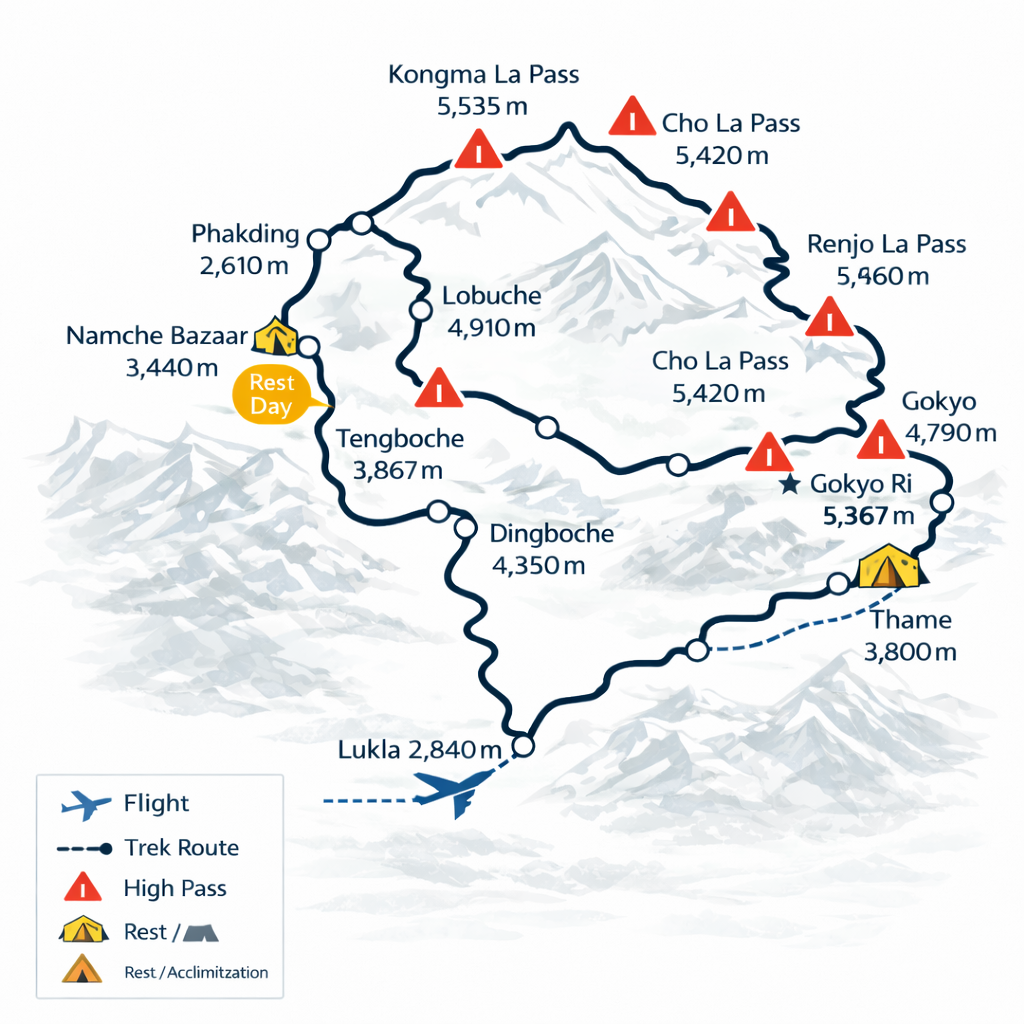
The Everest 3 Passes Trek is a challenging high-altitude trek in Nepal’s Khumbu region that crosses three major mountain passes—Kongma La (5,535 m), Cho La (5,420 m), and Renjo La (5,360 m)—while visiting Everest Base Camp, Gokyo Lakes, and several Sherpa villages.
The trek typically takes 18–21 days, depending on your pace, itinerary, and acclimatization needs.
The highest point is Kongma La Pass at 5,535 meters.
No, it is recommended for experienced trekkers due to its strenuous nature, high altitude, and long days.
The best seasons are spring (March–May) and autumn (late September–November) for stable weather and clear mountain views.
It is considered strenuous due to high altitude, steep climbs, and long trekking days. Good physical fitness and prior trekking experience are essential.
Train for at least 2–3 months with cardio (running, cycling, swimming), leg strengthening exercises, and regular hikes with a backpack.
Yes, at least 2–3 acclimatization days are built into most itineraries to help prevent altitude sickness.
You can expect 6–8 hours of trekking per day, with some days longer when crossing high passes.
No technical climbing skills are required, but you should be comfortable walking on snow, ice, and rocky terrain.
You’ll need a Sagarmatha National Park Entry Permit and a Khumbu Pasang Lhamu Rural Municipality Permit.
They can be arranged in Kathmandu or at the trek’s starting point in Lukla/Namche.
TIMS (Trekkers’ Information Management System) is not required for this trek under current regulations in the Everest region.
Costs range from USD 1,800–3,000 depending on the trekking agency, inclusions, and group size.
Typically, permits, guide and porter services, meals during the trek, accommodation in tea houses, and domestic flights to/from Lukla are included
Personal expenses, travel insurance, tips, and extra nights in Kathmandu are usually excluded.
Yes, insurance covering high-altitude trekking (above 5,500 m) and emergency helicopter evacuation is mandatory.
Tea houses and lodges along the route offer basic but comfortable rooms with shared bathrooms.
Meals include Nepali dishes like dal bhat, noodles, rice, potatoes, pasta, and soups. Western options are also available in many lodges.
Yes, but it must be purified. You can use water purification tablets or purchase boiled/filtered water.
While not mandatory, having a guide and porter is highly recommended for navigation, safety, and carrying heavy loads.
Tipping is customary—around USD 15–20 per day for a guide and USD 10–15 per day for a porter, divided among the group.
Symptoms include headache, nausea, dizziness, and shortness of breath. Proper acclimatization and hydration are key to prevention.
Yes, with proper preparation and an experienced guide. Weather and altitude are the main challenges.
Essential gear includes a down jacket, sleeping bag (-15°C), trekking boots, poles, gloves, layers, and a headlamp.
They are not always necessary but may be useful in early spring or late autumn when passes have snow or ice.
Yes, most trekking equipment can be rented or purchased in Thamel, Kathmandu.
The 3 Passes Trek offers a more adventurous and less crowded route, with added high passes, Gokyo Lakes, and panoramic viewpoints for a complete Everest region experience.
15 Trips
The Annapurna Base Camp Trek is a 7–12 day moderate hike from Pokhara through Gurung villages and rhododendron forests to Annapurna Base Camp (4,130 m),
The Ghorepani Poon Hill Trek is a short 4–6 day trek in the Annapurna region, famous for its sunrise views from Poon Hill (3,210 m) over Annapurna, Dhaulagiri, and Machhapuchhre.
The Upper Dolpo Trek is a remote Himalayan adventure featuring Shey Phoksundo Lake, Shey Gompa, high passes, and ancient Tibetan-Bon culture. It requires permits, a guide,
Kanchenjunga Base Camp (5,143m) in Nepal’s far east offers breathtaking mountain views, rich culture, and pristine wilderness—an adventurous trek through remote villages
Exclusive to your group – a tailor-made adventure with no unfamiliar faces
Design your adventure to match your pace and priorities.
Enjoy dedicated support from seasoned trekking professionals
Adapted altitude support, always on call
Start when you want, move how you like
Designed for couples, close friends, and families


Get the latest news, offers and inspiring travel stories straight to your inbox.
Sat:
Closed
Sun-Fri:
9:30-6:00

HGI Nepal is a trusted leader with decades of experience in crafting quality travel packages across Nepal’s diverse landscapes.