


Enjoy an exciting journey through the serene trails of the Dudh Kunda Trek, surrounded by pristine alpine forests, traditional Sherpa villages, and the magnificent backdrop of Mt. Numbur and other Himalayan peaks. Explore the sacred Dudh Kunda Lake, believed to fulfill wishes and purify the soul, while immersing yourself in the rich spiritual and cultural heritage of the Solu region.
9 Days
Moderate
10 Quest
4,560 m
12 Days
Moderate
10 Quest
3,700 m
The Dudhkunda Trek (also called the Dudhkunda Lake Trek) is one of Nepal’s hidden gems, offering an incredible blend of natural beauty, cultural richness, and spiritual significance. Located in the Solukhumbu region, south of the Everest region, this trek provides an off-the-beaten-path experience for trekkers who wish to escape the crowded trails of Everest Base Camp or Gokyo Valley. The route is relatively less explored, making it ideal for those seeking peace, solitude, and authentic encounters with the Himalayan way of life.
At the heart of this trek lies Dudhkunda Lake (4,560 m), which translates to the “Lake of Milk.” This sacred glacial lake rests at the base of Numbur Himal (6,959 m), a stunning peak revered by locals. The lake holds deep spiritual value for both Hindus and Buddhists, who believe that bathing in its holy waters cleanses sins and bestows blessings. Every year, during the festival of Janai Purnima (August), hundreds of pilgrims make the journey to the lake to perform rituals, offer prayers, and take a sacred dip. This spiritual aspect adds a unique dimension to the trek, blending adventure with faith and tradition.
The journey begins in Phaplu, a small town that can be reached by a short flight or a long road drive from Kathmandu. From here, the trail meanders through lush rhododendron forests, terraced fields, and traditional villages. Trekkers pass through settlements inhabited by Sherpa, Rai, Tamang, and Magar communities, each with their distinct culture, traditions, and hospitality. Along the way, one can experience the region’s vibrant lifestyle, from monasteries draped in prayer flags to farmlands cultivated with potatoes and barley. Staying in local tea houses and homestays enhances this cultural immersion, allowing trekkers to connect directly with the warmth of the local people.
The natural scenery along the Dudhkunda Trek is equally breathtaking. The trail passes through forests of pine, oak, and rhododendron, which are especially beautiful in spring when the hills burst into vibrant colors. Wildlife enthusiasts may also spot animals such as Himalayan thar, musk deer, pheasants, and even elusive snow leopards at higher altitudes. On clear days, trekkers are rewarded with spectacular mountain views, including Mount Everest, Lhotse, Makalu, Cho Oyu, Kanchenjunga, and Numbur Himal, making the trek visually as rewarding as it is culturally.
Unlike other high-altitude treks in the region, the Dudhkunda Trek is considered moderate in difficulty. It does not involve technical climbing, and the altitude is more manageable compared to routes like Everest Base Camp or Island Peak climbing. The walking trails are a mix of gentle ascents and descents across rolling hills, yak pastures, and alpine landscapes, making it suitable for both experienced trekkers and beginners with good fitness levels.
Depending on the chosen route and pace, the trek can take anywhere between 7 to 12 days. The standard itinerary includes gradual ascents to help with acclimatization, ensuring trekkers enjoy both comfort and safety along the way. With fewer trekkers on this trail, the journey feels more personal and immersive, offering a sense of discovery that is becoming rare in Nepal’s popular trekking regions.
In summary, the Dudhkunda Trek is a perfect alternative for those looking for a shorter and quieter adventure in the Himalayas. It combines sacred pilgrimage sites, vibrant cultural encounters, and stunning Himalayan landscapes, all in one journey. Whether it’s the serenity of Dudhkunda Lake, the majestic backdrop of Numbur Himal, or the warm hospitality of local communities, this trek leaves visitors with memories of both inner peace and outer beauty.
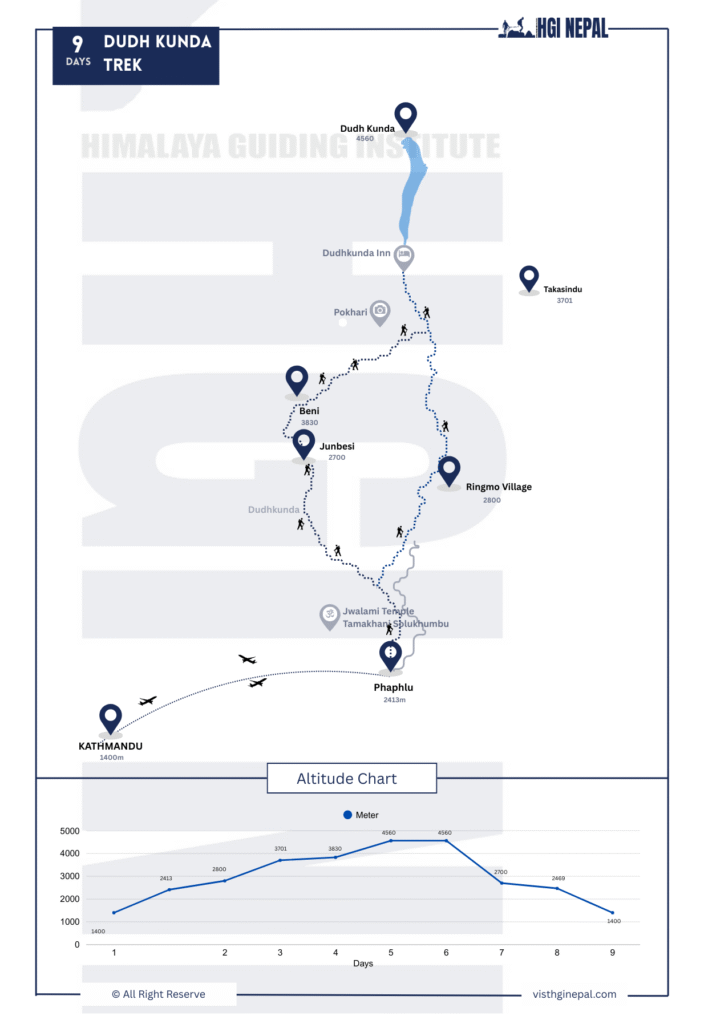
Elevation: 1400 m → 2413 m
Your journey to the sacred Dudhkunda Lake begins with a short yet scenic mountain flight from Kathmandu to Phaplu. The flight usually takes about 30–35 minutes, offering breathtaking aerial views of the rolling hills, deep river valleys, and glimpses of the Himalayan peaks in the distance. Unlike the busy Lukla flight, the journey to Phaplu is relatively calm, landing at a quiet airstrip surrounded by pristine landscapes in the Solu region of Solukhumbu District.
Upon arrival, you’ll spend some time exploring Phaplu (2,413 m), a charming Sherpa town that serves as the cultural heart of the lower Solukhumbu. Phaplu is less commercialized than the Khumbu region near Everest, which allows trekkers to witness authentic Sherpa life. Walking around the village, you’ll encounter traditional Sherpa houses, terraced fields, and locals engaged in farming and daily chores. The region is dotted with monasteries, chortens, and mani walls, reflecting the strong Buddhist influence that guides the lifestyle and spirituality of the community.
Phaplu is also known for its hospitality and cultural richness. Spending the day here gives you a chance to adjust to the altitude, enjoy local Sherpa food, and interact with the friendly villagers. If time allows, you can hike to nearby viewpoints or visit a monastery to get an early taste of the peaceful and spiritual atmosphere that defines this trek.
This easy first day not only marks the beginning of your Dudhkunda adventure, but also sets the tone for the journey ahead, blending cultural exploration with natural beauty. From here, the trail gradually ascends through forests, terraced farmlands, and remote settlements, leading you closer to the sacred Dudhkunda Lake (4,560 m) at the foot of the Numbur Himal.
Elevation: 2413 m → 2800 m
After exploring the beautiful Sherpa village of Phaplu (2,413 m), your trekking adventure officially begins with a pleasant and moderate hike to Ringmo. The trail gradually ascends through lush forests of rhododendron, pine, and oak, giving you a refreshing start to the journey. As you leave Phaplu behind, you’ll walk past scattered Sherpa and Rai settlements, where locals can be seen engaged in farming, tending livestock, or carrying out traditional daily routines.
The path offers a mix of cultural and natural beauty—stone walls carved with Buddhist prayers, colorful prayer flags fluttering in the wind, and occasional small stupas and chortens that mark the deeply spiritual landscape of the Solu region. Along the way, you will have opportunities to enjoy panoramic views of rolling green hills, terraced fields, and distant glimpses of snow-capped peaks like Numbur Himal.
Reaching Ringmo village (2,720 m) after about 4–5 hours of trekking, you’ll be welcomed into a quiet Sherpa settlement known for its simplicity and hospitality. Ringmo is surrounded by terraced farmland and forested hills, making it a peaceful stopover where trekkers can enjoy the warmth of local tea houses and home-cooked meals. The village also provides a great chance to interact with the locals and learn about their traditions, which remain untouched by mass tourism compared to the higher Khumbu region.
Spending the night in Ringmo not only helps you slowly acclimatize but also immerses you in the rural lifestyle of the Sherpa people. This day’s trek is relatively short and easy, serving as a perfect introduction to the scenic and cultural treasures that await on the way to Dudhkunda Lake (4,560 m).
Elevation: 2800 m → 3701 m
After a restful night in Ringmo village (2,720 m), the journey continues with a scenic trek towards Takshindu, a place renowned for its ancient monastery and sweeping views of the surrounding landscapes. The trail begins with a gradual climb through lush forests filled with rhododendron, oak, and pine, where bird songs and the rustle of leaves accompany your steps. During spring, the forest bursts into color as rhododendrons bloom, making this section especially beautiful.
As you ascend, you will pass through small Sherpa and Rai hamlets, where stone houses and terraced farmlands display the traditional lifestyle of the locals. The trail also features mani walls, prayer wheels, and fluttering prayer flags, reflecting the deep-rooted Buddhist culture of the Solu region. On clear days, trekkers can enjoy glimpses of towering peaks, including Numbur Himal (6,959 m), adding to the scenic delight of the trek.
After several hours of steady walking, you’ll reach Takshindu Pass (3,070 m), a beautiful vantage point offering panoramic views of Everest, Thamserku, and other Himalayan ranges. The pass is marked by prayer flags and stone cairns, creating a spiritually charged atmosphere that invites a short rest before continuing downhill towards the village.
Descending from the pass, you arrive at Takshindu (2,960 m), a culturally rich settlement best known for the historic Takshindu Monastery, one of the oldest and most revered in the Solu region. The monastery is an important center of Buddhist practice and offers a serene environment with intricate artwork, prayer halls, and chanting monks.
Spending the night in Takshindu gives you a chance to explore the monastery and engage with the warm-hearted Sherpa community. The location is peaceful and offers stunning evening and morning views of the surrounding landscapes, making it a memorable stop on the way to Dudhkunda Lake.
Elevation: 3701 m → 3830 m
After exploring the peaceful Takshindu Monastery (2,960 m) and enjoying the warm hospitality of the Sherpa community, the trek continues towards Beni, a long but rewarding day of walking through some of the most scenic landscapes in the Solu region. The trail begins with a pleasant descent along stone-paved paths that wind past terraced farmlands, traditional Sherpa and Rai houses, and vibrant forests of pine, fir, and rhododendron. During spring, the forest bursts with colorful blossoms, while autumn offers clear skies and crisp mountain views.
As the trek progresses, you will gradually move away from the busy villages and into quieter trails, experiencing the pristine beauty of rural Solukhumbu. Along the way, you may encounter yak herders tending to their animals in open pastures, and locals working in fields of barley, potatoes, and buckwheat. The diversity of culture is striking here—you’ll find not only Sherpa settlements but also Tamang, Magar, and Rai communities, each with their own traditions, languages, and lifestyles.
The journey is relatively long and involves both ascents and descents, but the changing scenery keeps the trek engaging. On clear days, you’ll be rewarded with sweeping views of Himalayan giants like Numbur Himal (6,959 m), Karyalung (6,681 m), and even distant glimpses of Everest and its neighboring peaks.
By late afternoon, you arrive at Beni (approx. 2,800 m), a small and charming village surrounded by forested hills and mountain vistas. Beni is often considered an important stopping point on the way to Dudhkunda Lake, providing trekkers with simple teahouse accommodations and a warm, welcoming atmosphere. The peaceful setting makes it an ideal place to rest and recover after a full day of trekking.
The evening in Beni offers a chance to immerse yourself in the quiet village life—sharing stories with locals, tasting traditional meals, and enjoying the serene views as the sun sets behind the mountains. Spending the night here prepares you for the next leg of the journey, which takes you closer to the sacred Dudhkunda Lake.
Elevation: 3830 m → 4560 m
The trail from Beni (2,800 m) to Dudhkunda Lake (4,560 m) is one of the most rewarding sections of the trek, as it leads you into the sacred heart of the Solu region. Leaving behind the cozy village of Beni, the trail gradually ascends through dense forests of pine, juniper, rhododendron, and birch. During springtime, the forested paths are painted in vibrant colors with blooming rhododendrons, while autumn offers crystal-clear skies and sweeping Himalayan views. The atmosphere becomes increasingly peaceful and spiritual as you move further away from settlements and deeper into the high-altitude wilderness.
As the trek continues, the landscape begins to change dramatically. The lush forests give way to alpine meadows and rocky terrain dotted with grazing yaks and small seasonal herder huts. The air becomes thinner, and trekkers must maintain a steady pace to adjust to the altitude. Along the trail, occasional mani walls, prayer flags, and chortens serve as reminders of the spiritual significance of this journey. Local pilgrims often walk the same paths, heading towards Dudhkunda for their annual religious rituals, adding a sacred dimension to the trek.
Gradually, the trail opens up to breathtaking panoramas of the surrounding peaks, including Numbur Himal (6,959 m), Karyalung (6,681 m), Mount Everest (8,848 m), Makalu (8,485 m), and even distant views of Kanchenjunga (8,586 m) on clear days. These dramatic vistas inspire a deep sense of awe as you approach the holy destination.
Finally, after a steady climb, you reach the sacred Dudhkunda Lake (4,560 m), also known as the “Lake of Milk.” Nestled at the foot of the majestic Numbur Himal, the turquoise glacial lake shimmers in the thin mountain air, surrounded by rugged cliffs and snow-capped peaks. For both Hindus and Buddhists, the lake holds profound religious importance. It is believed that taking a ritual dip in the holy waters purifies sins and grants blessings. During Janai Purnima (August), hundreds of pilgrims visit the lake for sacred ceremonies, turning this serene site into a vibrant spiritual hub.
Upon arrival, trekkers often take time to walk around the lake, soak in the peaceful atmosphere, and hang prayer flags as offerings. The sense of tranquility and spirituality here is unmatched, making Dudhkunda Lake not just a trekking destination but also a place of deep reflection and connection with nature and culture.
Overnight camping near the lake provides an extraordinary experience, as the clear night sky reveals thousands of stars, with the peaks of Numbur and Karyalung glowing under the moonlight. Waking up to sunrise over the holy lake is a memory that stays with trekkers forever.
Elevation: 4560 m
Spending an extra day at Dudhkunda Lake is a highlight of the entire trek, allowing trekkers to fully absorb the beauty, serenity, and spiritual energy of this sacred Himalayan destination. After the strenuous trek from Beni, this day provides the perfect balance of rest, exploration, and cultural connection.
Early in the morning, you can wake up to witness a mesmerizing sunrise over Numbur Himal (6,959 m) and the surrounding snowcapped peaks. As the first rays of sunlight hit the lake, its turquoise waters shimmer like a mirror, creating a breathtaking sight. Many trekkers and pilgrims use this quiet morning hour for meditation, prayer, or simply sitting by the lakeshore in peaceful reflection. If you are spiritually inclined, you may even join the locals in offering prayer flags or butter lamps to the sacred waters.
During the day, you can walk around the perimeter of Dudhkunda Lake, exploring the glacial landscape and taking in panoramic views of Everest, Makalu, Lhotse, Cho Oyu, and Kanchenjunga on clear days. The lake’s surrounding area is dotted with mani walls, chortens, and prayer flags, reflecting its significance as a holy pilgrimage site for both Hindus and Buddhists. According to local beliefs, taking a ritual dip in the lake cleanses sins and brings blessings of prosperity and health.
For those who enjoy hiking, short excursions around the lake and towards nearby ridges provide incredible vantage points of the Solu-Khumbu region. You may also spot wildlife such as Himalayan thars, blue sheep, or high-altitude birds circling the cliffs. The alpine meadows around the lake, especially in summer, are filled with colorful wildflowers that contrast beautifully against the stark mountain backdrop.
This day is not only about exploration but also about rest and acclimatization. Spending more time at higher altitudes helps your body adjust, reducing the chances of altitude sickness before beginning the descent. Trekkers can enjoy warm meals prepared by their guides or hosts, relax by the campsite, and share stories while soaking in the unique atmosphere of this sacred lake.
As the day winds down, the setting sun paints the peaks in golden hues, and night reveals a sky full of stars, unobstructed by pollution or city lights. The sight of the Milky Way arching over Dudhkunda Lake is an unforgettable experience, leaving trekkers with a deep sense of wonder and gratitude.
Spending an exploration day here ensures that the journey to Dudhkunda is not just about reaching a destination but about connecting deeply with the culture, nature, and spirituality of the Himalayas.
Elevation: 4560 m → 2700 m
After an unforgettable exploration at the sacred Dudhkunda Lake, today’s journey takes you on a long descent from the high glacial landscapes back into the lush valleys of the Solu region. The trek begins early in the morning with the crisp mountain air and a final glance at the shimmering turquoise waters of the holy lake and the towering Numbur Himal behind it.
The initial trail follows a gradual downhill path, winding past rocky moraines and alpine meadows before re-entering dense forests of rhododendron, pine, and oak. Along the way, you may encounter yaks grazing in the high pastures and hear the distant calls of Himalayan pheasants echoing through the valleys. The descent offers beautiful contrasts—leaving behind the barren highlands and gradually walking into green hills and terraced farmlands dotted with traditional stone houses.
As you trek further down, the route passes through small settlements and monasteries, where prayer flags flutter in the wind and locals greet you warmly. The scenery opens up to expansive views of the lower Khumbu and Solu valleys, with glimpses of Everest and Makalu in the distance on clear days. The trail also offers the opportunity to witness the lifestyle of the Sherpa, Rai, and Tamang communities, giving you a deeper cultural insight into the region.
By afternoon, you reach Junbesi (2,700 m), one of the most beautiful and culturally rich Sherpa villages in the Solu-Khumbu. Surrounded by green hills and farmland, Junbesi is known as the “cradle of Sherpa culture.” The village is home to ancient monasteries, including the famous Thubten Chholing Monastery, one of the largest Tibetan Buddhist monasteries in Nepal. Exploring Junbesi offers a glimpse into traditional Sherpa architecture, lifestyle, and spirituality.
After checking into a tea house or homestay, you can enjoy a warm Sherpa meal, interact with locals, or take a short evening walk around the village. The peaceful setting of Junbesi, combined with its cultural richness, makes it a perfect stop after days of trekking in the high mountains.
Elevation: 2700 m → 2469 m
After spending a culturally enriching night in Junbesi, the trek continues with a gentle descent towards Phaplu, marking the final stage of your journey through the Solu region before returning to Kathmandu. The trail gradually winds downhill through terraced fields, pine and rhododendron forests, and small Sherpa hamlets, offering a peaceful end to your highland adventure.
As you descend, the scenery becomes more pastoral and vibrant. You’ll pass farming communities tending to maize, potatoes, and barley, and witness daily life in the villages where traditional stone houses, mani walls, and chortens line the trail. The route provides ample opportunities to interact with locals and learn more about the Sherpa, Rai, and Tamang cultures that define this region.
Along the way, the forest opens up to occasional panoramic views of the surrounding peaks, including Numbur Himal, Karyalung, and distant glimpses of Makalu on clear days. The trail is moderate and easy to follow, making it a comfortable descent after the higher-altitude trekking days near Dudhkunda Lake.
Arriving in Phaplu (2,413 m) by afternoon, you’ll be welcomed back to this charming Sherpa town, the starting point of your Dudhkunda adventure. Here, you can rest, enjoy a warm meal, and reflect on the incredible landscapes, spiritual experiences, and cultural encounters of the trek. Phaplu’s quiet streets and hospitable tea houses provide a comfortable overnight stay, setting the stage for your return journey to Kathmandu via flight or road.
This trek from Junbesi to Phaplu not only concludes the highland portion of the journey but also allows trekkers to slowly re-acclimatize and absorb the natural and cultural richness of the Solu region before heading back to the bustle of Kathmandu.
Elevation: 2469 m → 1400 m
After completing the serene and spiritually enriching journey to Dudhkunda Lake and exploring the charming villages of the Solu region, your trek concludes with a short and scenic flight from Phaplu (2,413 m) back to Kathmandu (1,350 m). The flight typically takes around 30–35 minutes, offering stunning aerial views of terraced hills, deep valleys, and snow-capped peaks in the distance. As you ascend and then descend through the mountains, you’ll have a final opportunity to soak in the beauty of the Himalayas from a bird’s-eye perspective.
Arriving in Kathmandu, the vibrant energy of the city is a stark but exciting contrast to the peaceful landscapes of Solukhumbu. You’ll be transferred to your hotel in Thamel, where you can relax, freshen up, and reflect on the unforgettable experiences of the past several days. From the sacred Dudhkunda Lake to the lush forests, alpine meadows, and culturally rich villages of Sherpa, Rai, and Tamang communities, the trek leaves an enduring impression of natural beauty, adventure, and spiritual fulfillment.
The final day also allows trekkers to shop for souvenirs, enjoy a traditional Nepali meal, or simply unwind and share stories with fellow travelers. The sense of accomplishment and connection with the Himalayas is profound, making the Dudhkunda Trek a memorable off-the-beaten-path adventure in Nepal.
With the return to Kathmandu, the trek officially concludes, leaving you with lasting memories of sacred lakes, majestic mountains, and authentic Himalayan culture.
Your package covers domestic flights from Kathmandu to Phaplu. These scenic flights save significant travel time and provide stunning aerial views of the Himalayan ranges.
Entry to Sagarmatha National Park is mandatory for all trekkers. This fee ensures legal access to the park and contributes to conservation efforts and local communities.
The TIMS permit is required for all trekkers in Nepal. It registers you with the trekking authorities, ensuring your safety and tracking throughout the journey.
Full board service is included during the trek, covering breakfast, lunch, and dinner. Accommodation is provided in teahouses or lodges along the route, offering clean, safe, and basic facilities
Complimentary tea and coffee are available during meals and rest stops to keep you refreshed and warm throughout the trek.
Safe drinking water is arranged throughout the trek, either boiled, filtered, or purchased at teahouses.
An experienced English-speaking trekking guide accompanies you throughout the trek, providing expert guidance, cultural insights, and support for safety and acclimatization.
One porter for every two trekkers is provided to carry luggage, with a maximum of 18 kg per porter. This ensures your load is manageable and trekking is more comfortable.
The wages for your guide and porter throughout the trek are included, ensuring their full-time support and assistance.
Insurance coverage is provided for both your guide and porter, safeguarding them against accidents and emergencies during the trek.
The wages for your porter, who will help carry your luggage and ease your trekking experience, are included.
A comprehensive first aid kit is provided throughout the trek to handle minor injuries or illnesses promptly.
The cost of staying in hotels before or after the trek in Kathmandu and Phaplu is not included in the package. Travelers are expected to arrange and pay for their own accommodations in these cities.
Expenditures such as souvenirs, alcoholic beverages, bottled or canned drinks, snacks, laundry services, internet usage, and telephone calls are considered personal and are not covered by the package.
The package does not include travel insurance. All travelers are strongly advised to obtain comprehensive travel insurance that covers medical emergencies, trip cancellations or interruptions, lost or stolen luggage, and emergency evacuations, including high-altitude rescue
Flights to and from Nepal (your home country to Kathmandu and back) are not included in the package cost and must be booked separately by the traveler.
Tips for guides, porters, drivers, and other service staff are not included in the package. While tipping is not mandatory, it is customary and appreciated for good service, and the amount is left to the discretion of the traveler.
Any activities, tours, excursions, or services that are not explicitly mentioned in the itinerary, such as helicopter flights, sightseeing tours, or premium lodging upgrades, will incur additional costs.
Costs related to medical treatment, medicines, or emergency evacuations due to illness, injury, altitude sickness, or other unforeseen circumstances are not covered. These costs should be either insured under a travel insurance policy or paid out of pocket.
Airfare for domestic flights included in the trek package (e.g., Kathmandu–Lukla–Kathmandu) is usually included, but any extra flights, changes, or delays due to weather or personal reasons must be paid separately by the traveler.
Specialized trekking gear such as sleeping bags, down jackets, trekking poles, gaiters, or personal climbing equipment is not included and should be arranged individually unless rented through the trekking company.
For a comfortable and successful trek, having the right clothing, gear, and equipment is essential. One porter will be assigned for every two trekkers, with a maximum carrying capacity of 18 kg. This means each trekker is allowed to bring up to 9 kg of personal luggage.
As the porter will carry gear for two people, we recommend coordinating with a trekking partner and packing both sets of gear in a single duffel bag of at least 60 liters. In addition, each trekker should carry a personal daypack (20–30 liters) for essentials such as valuables, snacks, water, and important documents.
While personal preferences may vary, we suggest bringing only the necessary clothing and accessories for the trek. Any extra luggage you don’t need on the trail can be safely stored at your hotel or at the Discovery World Trekking office free of charge during the trek.
Dudhkunda Trek is in the Solukhumbu District, Province No. 1, Nepal, south of the Everest region.
Dudhkunda Lake (4,560 m) is a sacred glacial lake at the foot of Numbur Himal (6,959 m).
The lake is sacred for both Hindus and Buddhists; bathing in its waters is believed to cleanse sins and bring blessings.
It is also called Dudhkunda Lake Trek or Dudh Pokhari Trek.
The trek usually starts from Phaplu, accessible by flight or road from Kathmandu.
Typically, the trek is 7–12 days, depending on the chosen route and pace.
The highest point is Dudhkunda Lake at 4,560 meters.
The trek is moderate in difficulty and suitable for trekkers with good fitness; no technical climbing is required.
Spring (March–May) and Autumn (September–November) are ideal for clear skies, blooming rhododendrons, and pleasant temperatures.
Yes, it can be combined with Phaplu-Jiri routes or extended towards Everest Base Camp for longer adventures.
Yes, gradual ascent and proper rest are recommended to prevent altitude sickness.
Basic medical facilities exist in villages like Junbesi and Phaplu; severe cases require evacuation.
Children with good physical fitness can do it, but altitude adaptation should be carefully monitored.
Seniors in good health can undertake the trek with proper pacing and rest.
Stop trekking, rest, hydrate, and descend if symptoms worsen. Portable oxygen and medical evacuation are available in emergencies.
Tea houses, homestays, and basic lodges are available in villages along the route.
Vegetarian options are widely available; inform your guide for other dietary requirements.
Tap water should be boiled or treated; bottled water is available in most villages.
Sherpa, Rai, Tamang, and Magar communities inhabit the region.
Yes, staying in homestays and visiting monasteries allows cultural exchange.
Many monasteries welcome visitors respectfully; dress modestly and follow local customs.
Janai Purnima (August) is a major festival, when pilgrims visit Dudhkunda Lake for rituals.
Layered clothing for cold mornings and warm days, waterproof jackets, trekking boots, and gloves are recommended.
Trekking poles are highly recommended for balance on uneven terrain.
Hiring a guide is recommended for safety, navigation, and cultural insights.
Experienced trekkers can go independently, but local knowledge is beneficial for accommodation, trails, and permits.
Trekkers can fly from Kathmandu to Phaplu or drive via scenic routes to start the trek.
Exclusive to your group – a tailor-made adventure with no unfamiliar faces
Design your adventure to match your pace and priorities.
Enjoy dedicated support from seasoned trekking professionals
Adapted altitude support, always on call
Start when you want, move how you like
Designed for couples, close friends, and families


Get the latest news, offers and inspiring travel stories straight to your inbox.
Sat:
Closed
Sun-Fri:
9:30-6:00

HGI Nepal is a trusted leader with decades of experience in crafting quality travel packages across Nepal’s diverse landscapes.