

Enjoy an exciting journey through the remote trails of the Humla Limi Valley Trek, surrounded by rugged mountains, ancient Tibetan monasteries, and untouched highland villages. Explore the hidden beauty of the Limi Valley, where centuries-old traditions and spiritual heritage remain preserved in harmony with nature. This extraordinary adventure offers a rare glimpse into one of Nepal’s most isolated regions, combining pristine wilderness, rich culture, and breathtaking Himalayan landscapes.
17 Days
Moderate
10 Quest
4,620 m
12 Days
Moderate
10 Quest
4,620 m
The Humla Limi Valley Trek is a remote and culturally rich Himalayan journey located in northwestern Nepal, near the Tibetan border. This trek offers a rare opportunity to experience an untouched world of ancient Tibetan Buddhism, high-altitude wilderness, and authentic mountain village life.
Starting from Simikot, the trail follows the Karnali River through dramatic gorges, arid valleys, and high passes into the secluded Limi Valley—a region that has remained isolated for centuries. Along the way, trekkers encounter centuries-old monasteries, mani walls, and chortens, as well as herds of yaks and blue sheep roaming the alpine landscapes.
The journey passes through charming villages like Halji, Til, and Jang, where Tibetan culture is vibrantly preserved. These villages are home to the Lama people, and their lifestyle still reflects ancient traditions, unaltered by modern influence. The Rinchhen Ling Gompa in Halji is one of the oldest monasteries in the region and a spiritual highlight of the trek.
With dramatic views of Saipal Himal, Mount Kailash (on clear days), and the vast Trans-Himalayan Plateau, this trek is as scenic as it is culturally immersive. It also involves crossing high mountain passes such as the Nyalu La (4,949m), offering panoramic vistas of the Tibetan highlands.
Due to its remoteness, this trek demands a good level of fitness and a spirit of adventure. It’s best suited for trekkers looking for off-the-beaten-path experiences, away from crowded trails.
Elevation: 1400 m → 150 m
Your journey to the remote Humla Limi Valley begins with a scenic flight from Kathmandu (1,400 meters) to the bustling lowland town of Nepalgunj, located near the Indian border. The flight takes about an hour and offers impressive aerial views of the Himalayan foothills descending into the flat plains of the Terai. Upon arrival in Nepalgunj (150 meters), you’ll notice the stark contrast in climate and environment — from the cool mountain air of Kathmandu to the hot, humid subtropical conditions of the south. Nepalgunj is a major transport hub and an interesting cultural melting pot, home to a mix of Hindu, Muslim, and other ethnic communities. Spend the afternoon exploring the local markets or simply relaxing at your hotel in preparation for your early morning flight to Simikot the next day.
Elevation: 150 m → 2910 m
Early in the morning, you’ll board a small aircraft for a breathtaking mountain flight from Nepalgunj to Simikot, the gateway to the Humla region. This short but spectacular flight lasts around 45 minutes and takes you from the flat Terai plains to the rugged hills and valleys of northwestern Nepal. Upon landing in Simikot (2,910 meters), you’ll feel the noticeable drop in temperature and experience your first taste of the remote mountain environment.
After a brief rest and gear check, you’ll begin your trek towards Dharapuri. The trail gently ascends and descends through pine forests, traditional villages, and terraced fields. You’ll pass local farmers tending to their crops and get your first glimpses of the Karnali River. The 3- to 4-hour trek to Dharapuri is ideal for acclimatization and offers a peaceful introduction to trekking in this remote region. Overnight stay in Dharapuri, with dinner and rest under the stars in a serene Himalayan setting.
Elevation: 2910 m → 2670 m
Today’s trail leads you through quiet rural landscapes and farmlands. As you ascend gradually along the Karnali River, you’ll pass small villages inhabited by people from the Shauka community, known for their Tibetan-influenced lifestyle. The path is dotted with barley fields, buckwheat terraces, and fluttering prayer flags. The trail offers excellent opportunities to interact with locals and witness daily life in the high hills. After about 4–5 hours of trekking, you’ll arrive in Kermi — a peaceful settlement known for its ancient monasteries and hot springs, ideal for a relaxing dip. Overnight in Kermi.
Elevation: 2670 m → 2300 m
Leaving Kermi, the trail winds through thick pine forests and lush vegetation. You’ll cross several suspension bridges and continue along the banks of the Karnali River. As you descend slightly, the surroundings turn greener, with occasional encounters with mules and yaks transporting goods. En route, you can take a short side trip to enjoy natural hot springs. After a moderate 5–6-hour trek, you reach Shinjungma — a small campsite nestled in a serene forested area. Overnight in tents under the canopy of stars.
Elevation: 2300 m → 2900 m
Today involves a steady but gradual ascent through remote and rarely visited landscapes. The trail moves deeper into the Humla wilderness, offering quiet solitude, scattered yak pastures, and panoramic views of the surrounding ridgelines. You’ll trek for around 5 hours to reach Thalung, a seasonal herders’ settlement. This region is largely untouched and showcases the raw beauty of northwestern Nepal. Overnight in Thalung.
Elevation: 2900 m → 3660 m
Today is a highlight of the trek as you officially enter the culturally rich Limi Valley. The trail climbs gently before descending into Halji, one of the largest and most historic villages in the valley. The centerpiece here is Rinchhen Ling Monastery, a centuries-old spiritual hub built in the 11th century, adorned with ancient murals and prayer wheels. The Tibetan-style houses and prayer flags fluttering in the wind give a timeless feel to the village. Overnight stay in Halji.
Elevation: 3660 m → 3960 m
The trek continues westward through the majestic Limi Valley, where snow-capped peaks and dry mountain slopes surround traditional villages. You’ll pass barley fields, stone-walled compounds, and prayer mani walls as you make your way to Til — a picturesque village with strong cultural and religious ties to Tibet. This is another great opportunity to witness local life and learn about ancient Himalayan traditions. Overnight in Til.
Elevation: 3990 m → 3640 m
Descending from the highlands, you make your way to Hilsa, a border town near Tibet. This area is commonly used as a crossing point for pilgrims visiting Mount Kailash in Tibet. You’ll trek along rocky ridges and open terrain before reaching Hilsa, located on the banks of the Karnali River. The village offers insight into trans-Himalayan trade and Tibetan culture. Overnight in Hilsa.
Elevation: 3960 m → 3200 m
Leaving the border behind, you begin retracing your steps back into the interior Humla region. The trail winds through isolated valleys and rocky paths, eventually bringing you to Thulo Dunga, a quiet resting point with stunning views of the alpine landscape. Expect about 5–6 hours of trekking today. Overnight in Thulo Dunga.
Elevation: 3640 m → 3200 m
Following the course of the Karnali River, you’ll enjoy a relatively gradual walk through highland villages and arid cliffsides. The trail eventually reaches Tumkot, a charming village known for its Yalbang Monastery, one of the largest in the region. This stretch is rich in cultural and natural beauty. Overnight in Tumkot.
Elevation: 3200 m → 2400 m
Today’s trek is slightly easier as you descend further to the beautiful village of Yalbung. The trail follows gentle slopes with riverside paths and scattered pine trees. You’ll witness more farming activity and possibly herds of goats and yaks grazing along the route. Overnight in Yalbung.
Elevation: 2400 m → 2900 m
This return route brings you back to Kermi, following familiar trails. The path is scenic and relaxed, offering another chance to bathe in the hot springs and revisit monasteries if time permits. Overnight in Kermi.
Elevation: 2900 m → 2670 m
Retracing the trek, you’ll pass through quiet forests and farming terraces to reach Dharapuri once again. The walk offers time to reflect on the journey so far and enjoy the peaceful rhythm of rural mountain life. Overnight in Dharapuri.
Elevation: 2670 m → 2910 m
This is your final trekking day. You’ll climb gently through forested terrain and traditional villages to reach Simikot, completing the full loop of the trek. Rest, celebrate with your trekking team, and prepare for tomorrow’s flight. Overnight in Simikot.
Elevation: 2910 m → 150 m → 1400 m
After breakfast, take a scenic morning flight from Simikot to Nepalgunj. Upon arrival, transfer to your connecting flight back to Kathmandu. Depending on the schedule, you’ll arrive in the capital by afternoon, where you can relax and reflect on the unforgettable adventure in the remote Limi Valley.
Includes all domestic flights: Kathmandu to Pokhara, Pokhara to Jomsom, and return, providing scenic aerial views of the Himalayas.
Required to enter the restricted zone beyond Kagbeni.
Essential for entry into the Annapurna region.
Ensures trekker safety and registration.
Includes breakfast, lunch, dinner, and tea/coffee during the trek at local guesthouses or teahouses.
Boiled or filtered drinking water provided during trekking.
English-speaking licensed guide with extensive knowledge of the region.
One porter for every two trekkers (max 18 kg load shared).
Daily wages and allowances for field staff.
Includes guide’s airfare and associated charges.
Full insurance coverage for staff against accidents or emergencies.
Equipped for high-altitude trekking needs.
Hotel stays before and after the trek are not included in the package.
Lunch and dinner in cities are not covered.
Return flight from Pokhara to Kathmandu is not included.
Such as snacks, souvenirs, alcoholic beverages, internet, laundry, and phone calls.
Mandatory insurance covering high-altitude trekking, medical emergencies, and trip cancellations.
Flights to and from Nepal are not included.
Gratuities for guide, porters, and drivers are at your discretion.
Jungle safaris, canoeing, or cultural shows in Chitwan are extra.
Costs related to rescue, evacuation, or treatment must be covered by insurance or paid out-of-pocket.
Any optional tours, private upgrades, or itinerary extensions not mentioned in the package.
For a comfortable and successful trek, having the right clothing, gear, and equipment is essential. One porter will be assigned for every two trekkers, with a maximum carrying capacity of 18 kg. This means each trekker is allowed to bring up to 9 kg of personal luggage.
As the porter will carry gear for two people, we recommend coordinating with a trekking partner and packing both sets of gear in a single duffel bag of at least 60 liters. In addition, each trekker should carry a personal daypack (20–30 liters) for essentials such as valuables, snacks, water, and important documents.
While personal preferences may vary, we suggest bringing only the necessary clothing and accessories for the trek. Any extra luggage you don’t need on the trail can be safely stored at your hotel or at the Discovery World Trekking office free of charge during the trek.
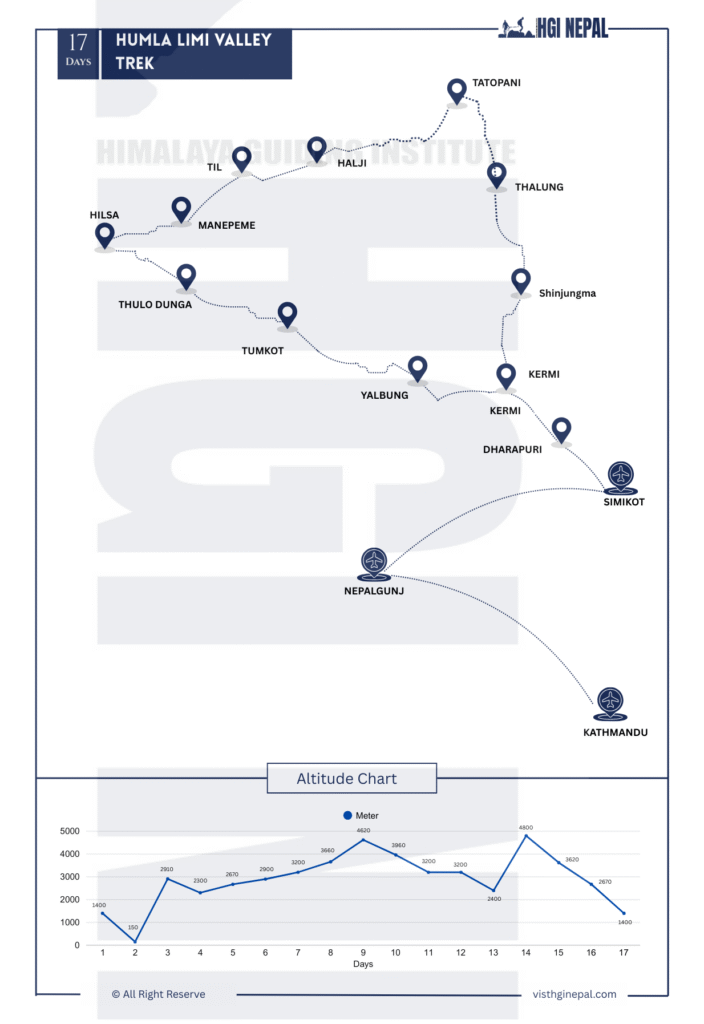
The Limi Valley is located in Nepal’s northwestern corner within Humla District, bordering Tibet. This region is one of the most isolated areas in Nepal, culturally and geographically connected to the Tibetan plateau. What makes the Limi Valley unique is its ancient Tibetan Buddhist culture, remote stone villages (Jang, Halji, Til), centuries-old monasteries, and landscapes untouched by modernization. It’s often called “Nepal’s last untouched Tibetan valley.”
The Humla Limi Valley Trek takes 17 days, starting and ending in Kathmandu. The trip includes your domestic flights (Kathmandu–Nepalgunj–Simikot), trek preparation, 13 days of trekking, and time for arrival, rest, and potential delays. It’s a fully guided and supported camping trek.
The trek is not recommended for complete beginners. While technical climbing is not required, you need previous experience of long-duration treks, good health, and the ability to walk for 5–7 hours per day over multiple days at high altitude.
The trek begins with flights to Simikot and follows the Karnali River valley, passes through Kermi, Yalbang, Tumkot, and crosses Nyalu La Pass (4,940m) into the Limi Valley. You visit Jang, Halji, and Til villages before exiting via Hilsa and returning to Simikot. The route forms a scenic circular loop, with rest days built in for acclimatization and exploration.
The highest point is Nyalu La Pass at 4,940 meters (16,207 ft). The Limi Valley itself sits between 3,600–4,000m, so much of the trek is at high elevation.
Yes. The itinerary is designed to gain altitude gradually. Rest and acclimatization days are usually scheduled in Kermi or Talung, and plenty of time is provided to adapt before crossing Nyalu La.
The ideal time is late spring to early autumn (May to October). These months offer stable weather, clear skies, and accessible trails. July and August can see some monsoon rain but are manageable due to the region’s rain shadow effect.
It’s considered strenuous and remote. You’ll be walking at high elevations on rough terrain, with daily trekking times of 5–7 hours, often without access to modern amenities. The trek involves camping in wilderness, crossing high passes, and limited access to communication and emergency facilities.
You should be in good physical condition with strong stamina and mental resilience. Prior trekking experience at altitude (e.g., Annapurna Circuit, Langtang, Everest region) is highly recommended. Cardio training, day hikes, and endurance building before the trek will greatly help.
You’ll need proper trekking gear suitable for high-altitude camping:
Warm layers and waterproof clothing
Trekking boots
A down sleeping bag (-15°C rating)
Trekking poles, gloves, hats, and sunglasses
Power bank or solar charger, personal hygiene kit, and water purification method
A full checklist will be provided, and sleeping bags/jackets can be rented in Kathmandu.
The trek passes through a restricted zone, so special permits are required:
Restricted Area Permit (RAP) for Humla
Simikot Rural Municipality entry fee
ACAP (Annapurna Conservation Area Permit) if applicable to routing
We will arrange all permits on your behalf. You’ll need a valid passport and passport-size photos.
Yes, travel insurance is mandatory. Your policy must cover emergency medical evacuation by helicopter up to 5,500m, high-altitude illness, and trip cancellation. Insurance proof is required before the trek begins.
Yes. We include all domestic flights (Kathmandu–Nepalgunj–Simikot round trip). Airport transfers are also included.
Flights to Simikot often face weather-related delays, especially in the mornings. We recommend adding 1–2 buffer days to your schedule. In emergencies, we can arrange helicopter service (extra cost). Our team will assist with rebooking and logistics.
All meals during the trek are included – breakfast, lunch, and dinner. Our trek crew prepares freshly cooked, hygienic meals daily. Meals include a mix of Nepali, Tibetan, and simple Western food: dal bhat, noodles, soup, pasta, tea, pancakes, etc. We cater to vegetarian and dietary needs if informed in advance.
In Kathmandu and Nepalgunj, you stay in comfortable 3-star hotels. During the trek, you will camp in high-quality tents, with separate tents for sleeping, dining, cooking, and toilets. In a few villages, we may use basic tea houses or homestays, if available.
Yes. We provide boiled or filtered water daily. You should bring reusable water bottles or a hydration system. For extra safety, consider using water purification tablets or filters.
No hot showers are available during camping. We provide warm water for washing. At campsites, private toilet tents are set up. In village teahouses, toilets may be basic squat types, and showers are rare and cold.
The trek is designed with proper altitude gain and rest days. Our guides monitor your health, and carry first-aid kits and Diamox (for altitude illness). You must stay hydrated and notify your guide of symptoms like headaches, nausea, or dizziness.
Yes. In case of serious illness or injury, we coordinate helicopter evacuation to Kathmandu or Nepalgunj. This is only possible if your insurance covers it and weather allows flying.
Mobile network is limited or non-existent in most of the trekking area. Only some villages like Simikot or Halji may have a weak signal. There is no Wi-Fi, so we rely on satellite communication for emergencies.
There are no charging stations in remote villages or camps. Bring a power bank (10,000–20,000 mAh) or a portable solar charger. Use devices wisely to conserve energy.
The price includes all meals, accommodation, flights, camping gear, guide/porter services, permits, and ground transportation. Personal expenses, snacks, insurance, and tips are not included.
Tipping is not mandatory, but it is highly appreciated. We recommend USD 100–150 per trekker, which is pooled and shared among the trekking crew (guides, porters, cook team). Tipping shows gratitude and supports local livelihoods.
Exclusive to your group – a tailor-made adventure with no unfamiliar faces
Design your adventure to match your pace and priorities.
Enjoy dedicated support from seasoned trekking professionals
Adapted altitude support, always on call
Start when you want, move how you like
Designed for couples, close friends, and families


Get the latest news, offers and inspiring travel stories straight to your inbox.
Sat:
Closed
Sun-Fri:
9:30-6:00

HGI Nepal is a trusted leader with decades of experience in crafting quality travel packages across Nepal’s diverse landscapes.