

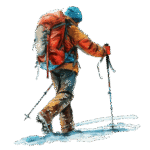
Trekking to Everest Base Camp (EBC) is a dream for many, but choosing the right month to go is only half the battle. If you’ve picked March, you’ve chosen one of the most rewarding times to visit the Khumbu region. It is the dawn of the spring season—the trails are coming alive, the legendary “Himalayan Blue” skies are at their clearest, and the mountaineering community is buzzing with energy as they prepare for the summit season.
However, March is a month of deep contrasts. You will experience the warmth of a spring afternoon in Phakding and the brutal, sub-zero reality of a winter night in Gorak Shep. At HGI Nepal, we’ve guided hundreds of trekkers through these trails, and we’ve learned that your success isn’t determined by your fitness alone—it’s determined by what is inside your bag.
Here is our comprehensive, expert-backed guide to packing for EBC in March.
In the Himalayas, we don’t think in terms of “thick clothes.” we think in terms of layers. This allows you to add or remove clothing as your body temperature changes with the incline and the wind.
Your base layer is your second skin. In March, you need materials that wick sweat away from your body so you don’t get a “sweat chill” when you stop to rest.
Merino Wool is King: Unlike synthetic fabrics, Merino wool stays warm even when damp and naturally resists odors. You’ll be wearing these for days at a time—your trekking partners will thank you for choosing wool.
Quantity: Bring two mid-weight tops and two pairs of thermal bottoms. Keep one set strictly for trekking and one dry set for sleeping.
This layer traps your body heat.
A Heavyweight Fleece: Perfect for those early 7:00 AM starts when the sun hasn’t yet hit the valley floor.
The “Down Sweater”: A thin, packable down jacket is excellent for lunch breaks at high altitudes where your heart rate slows and the cold sets in quickly.
This is your shield against the elements.
The Shell: A high-quality, breathable, waterproof jacket (like Gore-Tex). It must be windproof; the wind whistling off the Khumbu Glacier in March can feel like needles on your skin.
The Expedition Down Jacket: This is your “safety net.” It should be rated for $-15$°C to $-20$°C. You won’t hike in this, but the moment you arrive at your teahouse, you’ll put it on and stay in it until you crawl into your sleeping bag.
Your feet are your vehicle. If they fail, the trek ends.
Boots: You need waterproof, over-the-ankle trekking boots. In March, you will likely encounter “black ice” near the passes and slushy snow on the way to Base Camp. Ensure your boots have deep lugs for grip.
The “Break-in” Period: Never fly to Nepal with brand-new boots. Wear them for at least 50 kilometers of hiking or walking before you arrive.
Camp Shoes: Your feet need to recover. Bring a pair of lightweight Crocs or down booties to wear inside the teahouses.
Socks: Bring 4 pairs of heavy wool-blend socks and 2 pairs of thin “liner” socks. The liners help prevent the friction that causes blisters.
While teahouses provide a bed and a heavy blanket, they are not heated. In March, the temperature inside your room at Lobuche (4,940m) will be exactly the same as the temperature outside—well below freezing.
The Sleeping Bag: Do not settle for a “3-season” bag. You need a 4-season bag rated to $-15$°C ($0$°F).
The Liner: A silk or fleece liner adds a layer of hygiene and an extra $5$ degrees of warmth.
The Hot Water Bottle Trick: This is a guide’s secret. Fill a Nalgene bottle with boiling water before bed, wrap it in a spare sock, and put it at the bottom of your sleeping bag. It acts as a heater for your feet all night long.
The altitude and the dry air present unique challenges that beginners often overlook.
The air in March is incredibly dry. Breathing this dry air rapidly during steep climbs can irritate your lungs, leading to a persistent, painful cough.
The Buff: Wear a buff (neck gaiter) over your mouth and nose. It captures the moisture from your breath and warms the air before it enters your lungs. This is the single most important accessory you can carry.
Cold temperatures are the enemy of lithium batteries.
Power Banks: Bring a high-capacity power bank ($20,000$ mAh). Charging in teahouses is expensive and often relies on solar power, which can be unreliable in cloudy weather.
The Sleeping Bag Rule: Every night, put your phone, camera batteries, and power bank inside your sleeping bag with you. If they stay cold, they will be dead by morning.
You burn roughly $4,000$ to $5,000$ calories a day on the EBC trail.
Electrolytes: Water in the mountains is often stripped of minerals. Adding electrolyte powder to your water helps your body actually absorb the fluid, which is vital for preventing Altitude Sickness.
Comfort Food: Pack a few “cheat” snacks. When you reach high altitudes, your appetite often vanishes. A familiar chocolate bar or a bag of salted nuts can provide the morale boost and calories you need to keep moving.
Packing for Everest Base Camp in March isn’t about bringing everything; it’s about bringing the right things. Every gram in your bag should serve a purpose.
Remember, our porters are the backbone of your expedition. While they are incredibly strong, we strictly limit duffel bag weights to $15$kg ($33$ lbs) to ensure their safety and well-being. By packing efficiently, you aren’t just making the trek easier for yourself—you’re being a responsible and ethical traveler.
The mountains are calling, and in March, they are at their most beautiful. Pack smart, stay warm, and we will see you at the top of the world!
Ready to start your adventure? Check out our 12-Day Everest Base Camp Itinerary or contact our team for a personalized equipment consultation.


Get the latest news, offers and inspiring travel stories straight to your inbox.
Sat:
Closed
Sun-Fri:
9:30-6:00

HGI Nepal is a trusted leader with decades of experience in crafting quality travel packages across Nepal’s diverse landscapes.